
How Much Does a Custom Hotel Website Cost?
Real 2026 price ranges for a custom hotel website, what drives the cost up or down, and what usually gets billed separately.
A boutique-hotel owner once forwarded us three quotes for the same project: one for $3,500, one for $22,000, one for $58,000. Same property, the same rough scope described in each request. The owner’s actual question wasn’t “which of these is right” - it was “how is this even possible.”
It’s possible because “custom hotel website” isn’t a standardized product with one price tag. It’s a range of very different things wearing the same name, and the gap between them is exactly what this guide is for.
A few terms come up throughout this piece, so in plain terms:
Booking engine: the tool on a hotel's website that lets a guest search dates, check rates, and pay for a room directly.
API: a way for two pieces of software, like your PMS and your website, to send information back and forth automatically instead of someone copying it by hand.
ADA compliance: making a website usable for people with disabilities, such as a guest using a screen reader or unable to use a mouse. It's a US legal requirement, not just a nice-to-have.
Why there’s no single number
Three factors move the price more than anything else:
Scope of custom work. A site built from a designer’s original layout costs more than one built on a themed template with your logo dropped in, even if both are called “custom.”
Integration complexity. Your PMS (property management system - the software running your day-to-day operations, reservations, and housekeeping) and channel manager (the tool that pushes your rates and availability out to OTAs and your own site so they stay in sync) each have different APIs. Some connect cleanly with off-the-shelf plugins. Others need custom connector work, which is real development time, not a checkbox.
Content and photography needs. A site with existing professional photography and finished copy costs less to build than one where the developer is also coordinating a photo shoot and writing every page from scratch.
None of this is hotel-specific reasoning dressed up - it’s the same logic that makes any custom software project variable in cost. What’s specific to hotels is which systems have to talk to each other, and how much of that connection work is actually included in a quote versus billed on top of it.
Realistic price ranges by scope
Real 2026 pricing from agencies working in this space (Fusion Finesse Design; RevPARGenius; Hooray Agency, 2026), not a single vendor’s number:
| Tier | Price | What’s included |
|---|---|---|
| Template or semi-custom | $500-$5,000 | Pre-built theme with your branding applied, basic booking-engine integration, minimal custom design work |
| Custom boutique | $5,000-$20,000 | Original design work, proper booking-engine integration, technical SEO built in rather than bolted on - where most independent hotels and small boutique properties land |
| Fully bespoke | $20,000+, sometimes well past $50,000 | Deep PMS integration, custom guest-journey design, multi-property architecture, advanced features like AI guest chat - aimed at luxury properties and hotel groups, not a typical independent property |
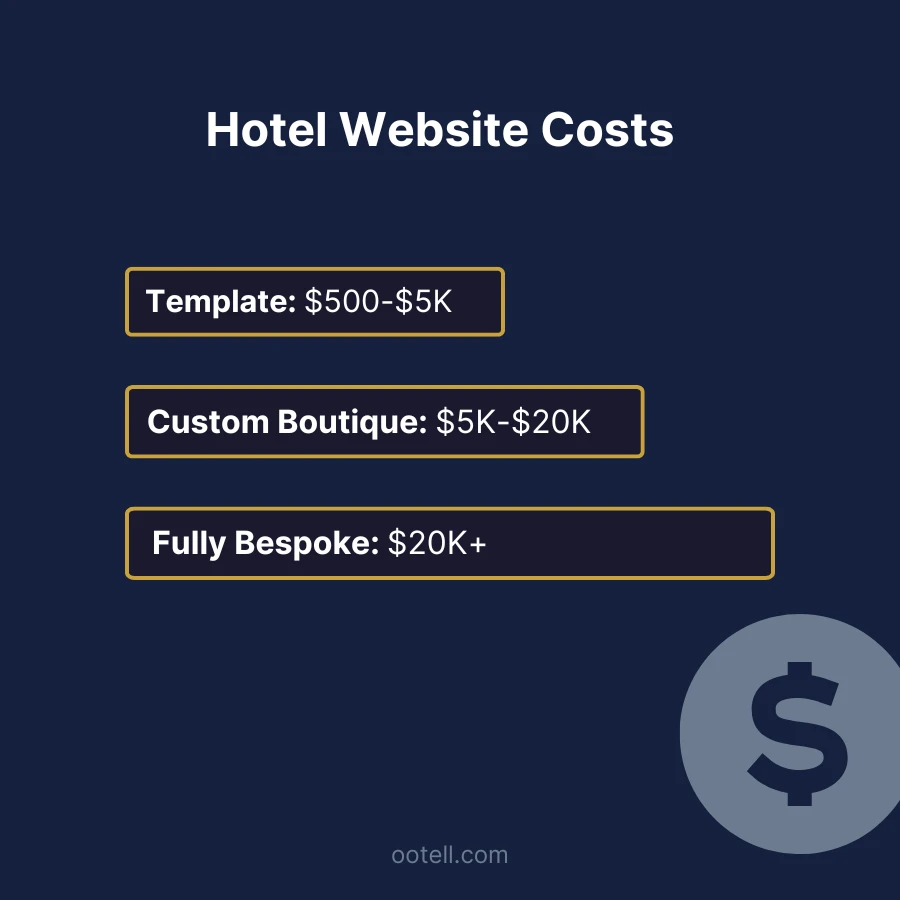
The spread between these numbers is real, not a sign that someone’s price is wrong. Two agencies quoting “custom boutique” work can land $10,000 apart depending on how much design exploration, integration depth, and revision time is actually bundled into the number.
For reference, our own current pricing for a full custom build (design, development, PMS/channel-manager integration, and launch) starts at $5,900 for launch partners, $11,900 regular price - solidly in the custom-boutique range above, without the fully-bespoke price tag most independent properties don’t actually need.
What’s usually priced separately
Ask specifically about each of these before comparing quotes side by side - vendors bundle them differently, and an apparently-cheaper quote sometimes just excludes more:
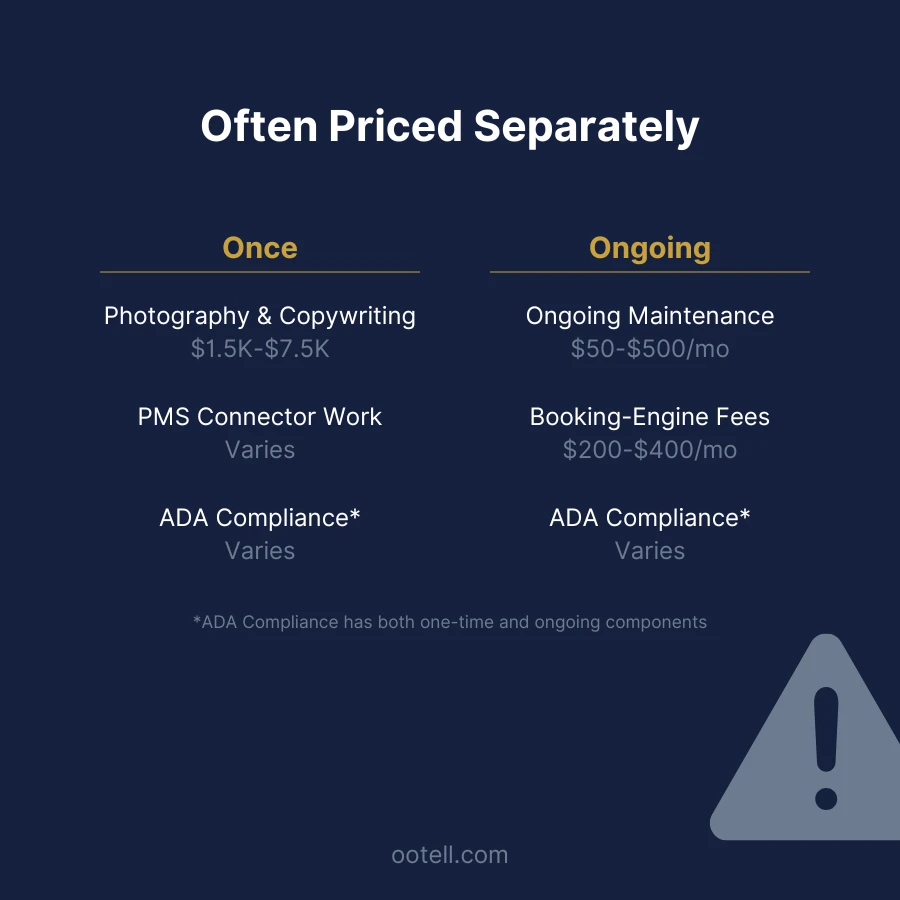
- Photography and copywriting (one-time). Professional hotel photography alone typically runs $1,500-$7,500 per shoot day depending on property size and crew (mike-butler.com, 2026); copywriting is usually quoted separately on top of that.
- Ongoing maintenance and support (recurring). Security patches, content updates, and technical support after launch are commonly a separate monthly line, typically $50-$500/month depending on scope (Gravitate Design, 2026), not included in the build price.
- Booking-engine platform fees (recurring). Many booking engines charge their own monthly fee, often $200-$400, on top of what you pay your website vendor - that’s a subscription to the booking platform, not to your developer.
- Deep PMS/channel-manager connector work (one-time). Standard supported integrations are usually included; anything custom, beyond what the platform natively supports, is real engineering time billed separately. Unlike the other items here, this one genuinely has no reliable published price range - it depends entirely on your specific PMS’s API, so get a number from your vendor rather than budgeting off an industry average.
- Accessibility compliance work (one-time remediation, plus recurring monitoring). ADA-related remediation typically runs $2,500-$25,000 once depending on how much retrofitting an existing site needs, plus $500-$1,500/month for ongoing monitoring - a real, often-overlooked cost category for hospitality sites specifically (Hooray Agency, 2026).
How much automation do you actually need?
“Template” and “custom” describe how a site looks, not how it works behind the scenes - and that second thing is what actually drives both cost and value. A beautifully custom-designed site can still just be a contact form in a nicer wrapper. A templated site can be wired into a fully automated, real-time booking flow. What matters is how deep the automation goes, not how bespoke the layout is.
Three real tiers, independent of design:
| Tier | What it is | Tradeoff |
|---|---|---|
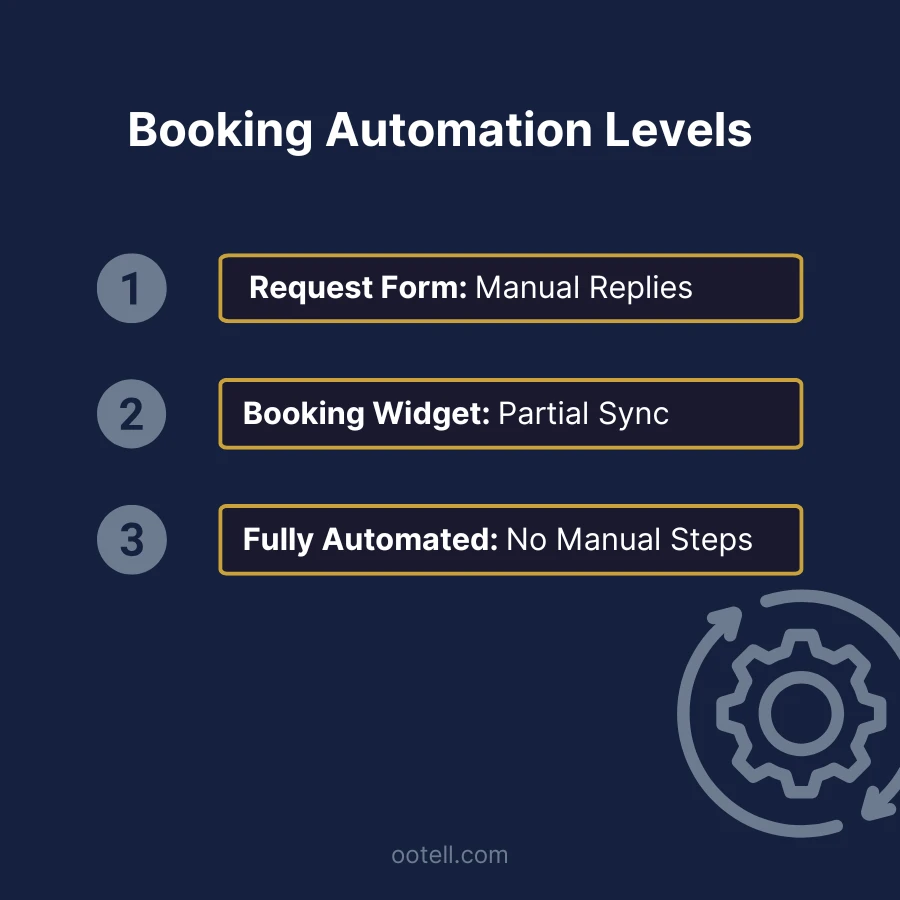
| Booking-request form | Guest submits dates and contact details, a staff member checks availability and rates by hand and replies by email or phone | Cheapest to build and fine for very low volume, but every booking costs staff time and guests increasingly expect an instant answer |
| Standard booking-engine widget | Rates and availability show in real time, but syncing back to the property’s actual PMS may be partial or need manual reconciliation | Where most hotel websites actually sit today |
| Fully automated flow | Real-time two-way sync with the PMS and channel manager, automatic confirmations, guest data flowing straight into CRM and guest-messaging tools with no manual step | Most expensive tier, because it’s real engineering work connecting live systems, not a design choice |
As a rough guideline, a very small property with low booking volume may never outgrow a request form. Independent hotels above about 20 rooms, or any property juggling multiple OTAs and a loyalty program, are usually where the staff time saved by full automation starts to outweigh the extra build cost (RevPARGenius, 2026).
Design tier and automation depth are two separate dials a vendor can set independently - a quote should tell you where each one actually lands, not just what tier of “custom” they’re calling it.
Cost vs. value
The honest framing here isn’t a guaranteed return - it’s what a deeper, more automated booking flow is actually built to do differently: fewer manual steps for staff, availability and rates that are always accurate because they’re synced instead of manually maintained, and a design that makes your property easier to choose when a guest has several tabs open comparing options.
Whether that’s worth the price difference comes down to your own numbers. If you don’t yet know what your website’s booking conversion rate actually is, hotel website conversion benchmarks is the place to start before you request quotes - it’s a lot easier to judge whether a redesign is worth the cost once you know what you’re improving from.
Once you’ve got a budget range in mind, here’s what should actually be in scope for the money: hotel website redesign checklist.
If you’d rather skip the guesswork, talk to us for 15 minutes and we’ll give you an actual number for your specific property, no obligation.
Build Greatness! 🍀
Michael
Frequently asked questions
- How much does a custom hotel website typically cost?
- Most independent and boutique properties land somewhere between $5,000 and $35,000 for a real custom build, depending on design complexity, booking-engine integration, and how many systems it needs to connect to. Template sites run lower ($500-$5,000), though a low price often (not always) comes with a shallower, less automated booking flow - the design tier and the automation depth are separate questions.
- Does the quoted price usually include PMS and channel-manager integration?
- Basic booking-engine integration is usually in the base quote. Deeper integration work, custom connectors, or anything beyond a standard supported connection is often priced separately, and the size of that work depends entirely on your specific PMS's API. Ask for this explicitly before comparing quotes.
- Is a template builder actually cheaper in the long run?
- Cheaper upfront, not necessarily cheaper over time - but the real question isn't template vs. custom design, it's how automated the booking flow behind it is. A templated site wired into a fully automated, PMS-synced flow can outperform a beautifully custom site that's just a request form. See the automation-depth section above.
- What should I budget for after the site launches?
- Beyond hosting and domain renewal (typically under $50/month), budget for content updates, security/plugin maintenance, and whatever ongoing support tier you choose. Booking-engine platforms often carry their own monthly fee on top of the website build itself, separate from what you pay your website vendor.